Sarah Chen
You have viewed the flat twice, agreed a price with the seller’s agent, and are about to hand over the Option-to-Purchase cheque. Somewhere between the second viewing and the OTP, most Singapore home buyers spend a total of about ninety seconds thinking about the aircon system in the property they are about to buy. And every year, quietly, this is the omission that costs them the most: a resale HDB with a fifteen-year-old system 3 discovers a S$4,800 replacement bill in month four; a resale condo with ducted aircon uncovers hidden mould that runs S$5,000 to remediate; a landed handover reveals a compressor with a hairline refrigerant leak that needs a S$1,800 repair before the year is out.
This guide walks through the aircon inspection every Singapore home buyer should run before signing the OTP, the surface checks you can do yourself in ten minutes, the questions to put to the seller’s agent, and the specific findings that justify money off the purchase price. It covers HDB flats, condominiums (including the ducted systems common in older private developments), and landed property. The premise is simple: aircon condition is one of the largest hidden line items in your first year of home ownership, and unlike stamp duty or valuation fees, it is negotiable, but only if you actually check.
Typical hidden cost: S$2,000–S$8,000 in year one, depending on system size and how deferred the maintenance was.
What to check at viewing: Age of the outdoor compressor, mould smell at indoor unit startup, water staining on walls, rust on the outdoor unit, presence of any service records.
What to ask the seller: Installation year, service provider name, servicing frequency, any refrigerant top-ups in the last three years, warranty transfer terms.
The most expensive part: The outdoor compressor. Replacement runs S$1,200–S$2,500; a full system overhaul S$3,500–S$5,500. Age (typically 10–15 years in Singapore usage) is the primary signal.
The hidden killer for ducted systems: Mould in the ductwork. Common in older condos; remediation costs S$800–S$2,500 and is often not visible until the system is opened up.
Professional pre-purchase inspection: S$150–S$300 typically. Worth it for any system 8+ years old, any ducted or VRV/VRF setup, or where the seller cannot produce service records.
Negotiation reality: Most Singapore sellers will absorb S$500–S$3,000 in agreed aircon repair credits when confronted with a documented inspection finding, particularly late in the OTP process where they do not want the deal to fall through.
The following is what you can check yourself, without a technician, during the second viewing. Bring a phone with a torch, a note-taking app, and a willingness to look inside the aircon casing where the seller permits.
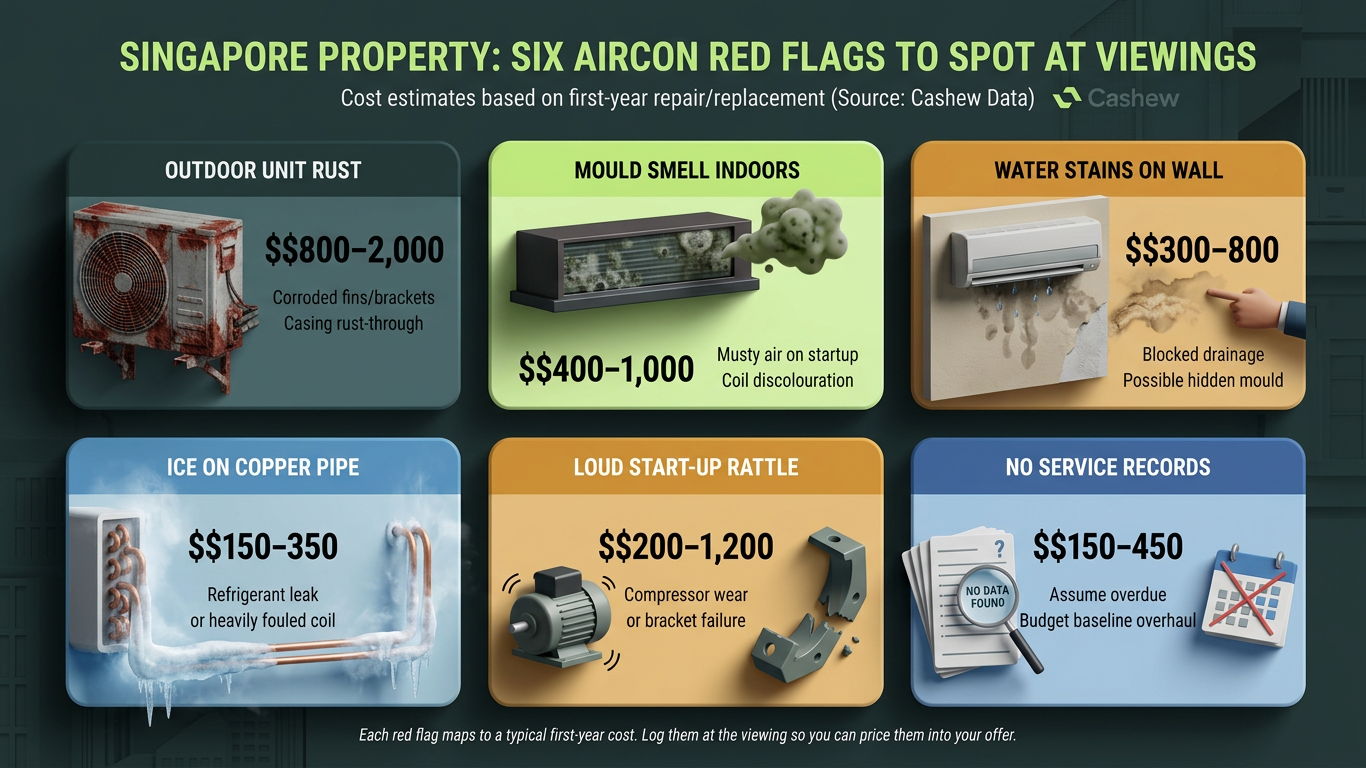
Six aircon red flags that take under two minutes each to check at a property viewing. Each one has a typical first-year cost that maps directly into your negotiation position.
The outdoor unit, the box that sits on the ledge (HDB), balcony bracket (condo), or ground-mounted pad (landed), is where you gather the most information.
Age. Every outdoor unit has a serial plate on the side or back showing the manufacturing date. Look for a sticker or engraved plate marked "MFG" or "Date" followed by a month and year. Anything older than 10 years is approaching the end of its natural service life; older than 12 years, and you should assume a full replacement within 2–3 years.
Rust and corrosion. Look at the mounting brackets, the fin coils, and the casing seams. Surface rust is normal in Singapore’s humidity; heavy flaking rust on the brackets or through-corrosion of the casing means the unit has been outside for a long time and has been either badly installed or badly maintained, sometimes both.
Refrigerant line insulation. The two copper pipes running from indoor to outdoor unit are wrapped in black foam insulation. If the insulation is cracked, missing, or crumbling, the pipes have been exposed to sun and heat, which reduces the system’s efficiency and often signals a leak-prone installation.
Fan and coil condition. Look at the fins on the outdoor unit, the fine aluminium blades on the sides. Bent, flattened, or heavily fouled fins reduce heat dissipation and force the compressor to work harder. A well-maintained unit’s fins are straight, clean, and evenly spaced.
Mould smell at start-up. Ask the agent to run the aircon for two minutes if it is not already on. A musty, damp, or sour smell in the first thirty seconds after start-up is one of the strongest single indicators of mould on the evaporator coil and inside the drainage pan. It also indicates a long-overdue service history.
If the smell is present, signs of aircon mould you can smell and see is a useful reference for what you may be dealing with. Mould in a resale unit is fixable, but it should be priced into the negotiation.
Water staining on the wall or ceiling below the indoor unit. A brownish or yellowish stain suggests past drainage issues, a blocked drain pan or slipped drainage line. If the staining is fresh, the issue may still be present.
Discolouration on the coil. Where you can see the coil (usually behind a removable filter panel), a healthy coil looks like clean aluminium. Grey, brown, or greenish discolouration is biofilm and mould, and it directly indicates the aircon servicing intervals recommended for Singapore usage are being missed.
Vent airflow. Hold your hand at the vent. Weak or uneven airflow can mean a dirty coil, a slipping fan motor, or a partially collapsed duct, all of which need a technician to properly diagnose, but any of which should raise the question of what else has been neglected.
Ducted aircon systems, where a central fan-coil unit blows conditioned air through concealed ductwork to multiple rooms, are common in older condos, in landed property, and in some newer luxury developments. They cool efficiently and look elegant (no visible wall units), but they carry a hidden risk that split systems do not: the ductwork accumulates dust, condensation, and, over time, mould, and all of that is invisible from the room. At the viewing, work through the following.
Ceiling access panels. A ducted system requires periodic servicing of the concealed air-handling unit (AHU), and that means access panels in the false ceiling, usually a small square hatch above each AHU location. If the ceiling has no access panels at all, the system either cannot be serviced without cutting the ceiling open, or has not been properly serviced in years. Either way, that is a S$500–S$1,500 issue at your expense once you take over.
Duct connections and integrity. Where you can look through an access panel or an open ceiling section, check that the flexible duct sections are properly clamped to the AHU and to each register outlet. Detached or partially detached ducts are a common finding in older installations, the ground-level symptom is uneven cooling between rooms, and the fix is a technician visit to reseat the ducts and reseal the joints.
Musty smell at the ceiling vents. A faint musty, damp, or sour smell at the ceiling vents is the strongest single indicator of mould inside the ductwork. Prolonged exposure to airborne mould spores in the home is a recognised trigger for respiratory sensitivity, aggravated asthma, chronic sinus issues, and allergic reactions, particularly in young children, older adults, and anyone with a pre-existing respiratory condition (see the health impact of aircon mould for the clinical picture). If the smell is present and the seller cannot produce duct cleaning records, budget S$800–S$2,500 for professional remediation in the first year and price it into your offer.
AHU filter accessibility. Locate an AHU access panel and check whether the return-air filter can be pulled out and cleaned without dismantling the ceiling. A ducted system whose AHU filter is difficult to access will not have been cleaned regularly, which quietly halves the cooling efficiency and doubles the running cost.
Ceiling stains around the AHU. Yellow, brown, or greenish stains on the ceiling surrounding the AHU indicate past condensate overflow: the drain pan blocked, water spilled, and the ceiling absorbed it. Even if the stain is old, the drainage arrangement should be inspected by a technician before you close, because a recurring overflow inside a false ceiling is how mould colonies establish in the first place.
The seller is legally required to disclose defects only if directly asked. Ask directly. All of the following are reasonable requests that any well-organised household should be able to answer, and the answers to them together form the paper trail for your negotiation.
When was the aircon system installed, and by which contractor?
How often is the system serviced, and who is your current service provider?
Do you have the last two years of service receipts or invoices?
Has the system had any refrigerant top-ups in the last three years? For which units?
Is any part of the system still under warranty, and is that warranty transferable?
Have any units been replaced during your ownership? If so, which and when?
Are there any service contracts in place, and can they be transferred or cancelled?
If the seller cannot answer any of these, assume the worst on each point and price accordingly. In practice, a "we service it as needed" answer is code for "we do not service it on any schedule", which puts the units in the S$400–S$600 catch-up-overhaul bracket immediately.
A compressor is the motorised pump inside the outdoor unit that circulates refrigerant through the system. It is functionally the engine of the aircon, and, like an engine, it is by far the most expensive single component to replace: typically S$1,200–S$2,500 for a residential inverter compressor, all-in.
Compressor life in Singapore residential use runs 10–15 years for a properly installed and maintained unit. Aggressive undersizing (a unit forced to run at maximum load continuously in a large room), long-run neglect, and refrigerant undercharge all shorten this. The single biggest signal for a stressed compressor is a loud starting rattle followed by rising running noise, but by the time you can hear this at a viewing, the compressor is often within 12 months of failure.
The four-question compressor check:
What year is the outdoor unit? The serial plate answers this. Take a photo.
Are the refrigerant lines properly insulated all the way from indoor to outdoor? Visual check. Look for exposed copper, cracks, and missing foam.
Is the unit level and firmly bolted to its bracket, or has it settled with vibration? Visual check. Unlevel units run louder and wear the compressor faster.
What sound does the outdoor unit make on start-up? Listen for 60 seconds. A healthy inverter compressor spins up smoothly; a stressed one rattles for the first 10–20 seconds.
A compressor showing any two of the following is one you should budget to replace or overhaul within 24 months: age above 10 years, cracked line insulation, visible heavy corrosion, or loud vibration on start.
HDB installations are almost always wall-mounted split units on external ledges. Access is usually straightforward for inspection, service, and replacement. The most common issues in resale HDB: outdoor units left on the ledge for 10+ years with intermittent servicing, refrigerant lines routed poorly (particularly in older 4- and 5-room flats where installers took shortcuts through the utility area), and rusted brackets. Replacement of a full HDB system 3 typically costs S$3,500–S$5,500. See the aircon installation cost breakdown for current 2026 figures by system size and brand tier.
Condo installations vary widely. Newer developments (post-2015) typically have well-installed split systems with condensers on a balcony or dedicated aircon ledge. Older developments may have ducted systems, awkwardly placed condensers, or restrictions on the type of condenser that can be installed. Always check whether the MCST has any restrictions on external unit brands or placement, and some older developments require specific low-noise models, and some restrict outdoor unit relocation altogether. Ducted systems in condos deserve the extra scrutiny described above.
Landed properties often have multi-zone split systems or, in higher-end builds, VRV/VRF systems, larger commercial-grade multi-zone systems that can serve 5–10 rooms from a single set of outdoor units. VRV replacement is a S$15,000–S$40,000 exercise; a compressor failure in one, out of warranty, is S$3,000–S$6,000. If the property has a VRV/VRF system, the seller should be able to name the maintenance contractor and produce a full service history, since the systems are commercial-class and their upkeep is documented as standard. The absence of either is a serious red flag on a property that may otherwise look immaculate.
A dedicated pre-purchase HVAC inspection by an aircon technician costs S$150–S$300 in Singapore and is worth commissioning when at least one of the following is true:
The system is 8 or more years old.
Any part of the system is ducted, VRV, or VRF.
The seller cannot produce recent service records.
You saw one or more red flags at the viewing.
The property is being sold as "renovated" with claimed new aircon (see the note below on partial replacements).
The inspector attaches a refrigerant pressure gauge, measures air-out temperature at each unit, opens filter panels, checks compressor start current, and looks at ductwork if accessible. The written report produces numbers, not opinions, and those numbers are what you take to the negotiation.
Sellers preparing a resale property sometimes commission a rushed installation of one new indoor fan-coil unit, usually the one in the master bedroom, while leaving the older outdoor compressor and remaining indoor units in place. The visible-from-viewing signal is a new-looking unit; the underlying system is the same aged system 3 or system 4.
The check is to look at all indoor units and the outdoor compressor together. If one indoor unit is visibly newer than the others and the outdoor compressor is old, the "new aircon" claim is at best incomplete. Ask the seller for the installation invoice for what was replaced, exactly, and price the remaining old components at their real replacement cost. This is one of the more common patterns that inflates the eventual first-year budget: the buyer paid a premium for "renovated with new aircon", and got one new indoor unit stapled onto a 12-year-old system.
The negotiation is the whole point of doing the inspection. Sellers in a broker-managed OTP process do not usually walk away from a S$500–S$3,000 aircon credit if the finding is documented, particularly if it lands late in the negotiation, when the alternative is the deal falling through. Use the table below as opening figures; they represent the typical starting positions Singapore buyers commonly negotiate down from. Support each figure with your inspection notes (photographs, service-record gaps, and, if commissioned, the inspector’s report).
| Finding at viewing or inspection | Typical offset off OTP price |
|---|---|
| Outdoor unit >12 years old, servicing intermittent | S$3,000–S$5,000 |
| Compressor showing failure signals (loud start, cracked insulation, heavy rust) | S$1,500–S$2,500 |
| No maintenance records for the last 12 months | S$400–S$600 |
| Mould evidence at any indoor unit | S$600–S$1,200 per unit |
| Ducted system with no cleaning records in the last 3 years | S$1,000–S$2,500 |
| Refrigerant leak signs (ice on line, hissing, weak cooling) | S$300–S$500 |
| Water staining suggesting past drainage failure | S$300–S$800 |
| Recently-replaced single indoor unit only, older outdoor compressor | S$2,000–S$3,500 |
These are opening figures. The realistic settlement is commonly 50–70 per cent of the opening ask, particularly if the seller has multiple interested buyers. In broker-managed transactions, the negotiation is usually done as a repair credit at completion rather than a headline price reduction, because sellers care about the headline number for their own records, and the effect on your total cash outlay is the same.
Whatever the inspection finds, plan for a full chemical wash of every unit within the first two months of moving in. This gives you a baseline: clean coils, refreshed drainage, verified refrigerant charge. A chemical wash costs S$80–S$120 per unit at 2026 Singapore prices, and it is standard practice for any homeowner taking over a resale unit with unclear service history. Rather than defaulting to the seller’s technician, whose maintenance record on the units is the very thing you have just been auditing, use the airconservices.sg directory to compare aircon service firms and their pricing by area, service type, and customer rating. From that point forward, set up a quarterly service schedule and keep the receipts, which become the paper trail for the next buyer, whenever you sell.
The takeaway for buyers at the OTP stage
Ten minutes of aircon inspection at the second viewing plus (where warranted) a S$150–S$300 professional inspection is one of the highest return-on-effort checks in the Singapore home-buying process. The finding either gives you real money off the OTP price or reassures you that the S$2,000–S$8,000 hidden line item is not there. Either result is worth doing.
How much can aircon issues actually cost after buying a resale home in Singapore?
Between S$2,000 and S$8,000 in the first year is typical, depending on system size and how deferred the maintenance was. A full HDB system 3 replacement is S$3,500–S$5,500; a compressor swap is S$1,200–S$2,500; a full chemical overhaul programme for a neglected system is S$450–S$750. Ducted systems add a further S$800–S$2,500 for remediation if mould is present.
Can I ask the seller for aircon service receipts before I sign the OTP?
Yes, and you should. It is a normal request, and any well-organised household will have the receipts or be able to obtain them from their service provider. If the seller declines to provide them, or claims their technician cannot supply copies, treat it as an implicit disclosure that the service history is patchy, and price accordingly.
Should I test every aircon unit during the viewing?
Yes. Ask the agent to run every unit for at least two minutes. Feel the air, smell it at the vent, listen for rattling from the outdoor compressor, and look at the wall below the indoor unit for water staining. Two minutes per unit is enough to catch the most common serious issues before you shortlist the flat.
How do I read the age of an aircon unit?
Look on the outdoor unit for a serial plate, usually on the side, back, or top of the casing. The manufacturing date is a month and year, marked "MFG" or "Date". If the plate is missing or worn away, the aircon technician can usually derive the year from the model number and refrigerant type (R32 systems are almost all post-2018; R410A systems are pre-2018 or early transition).
Is mould in a resale aircon a dealbreaker?
Not usually. Mould is fixable with a chemical overhaul and, for ducted systems, ductwork cleaning. But it should be priced into the negotiation, and if the system is old enough that mould has affected the coil metallurgy, the fix may need to include a coil or full unit replacement. Get a technician’s opinion before deciding whether to walk from the deal.
Do I need a professional pre-purchase aircon inspection for every property?
No. For newer flats (systems under 5 years) with reasonable service records, a visual check at the viewing is sufficient. For older systems, ducted systems, VRV or VRF setups, and any property being sold "as-is renovated", the S$150–S$300 inspection is very good value: it produces numbers you can take to the negotiation.
How do I negotiate the aircon findings without antagonising the seller?
Present the findings factually, with photographs and (where you have one) the inspector’s report. Frame the ask as a repair credit at completion rather than a headline price reduction, and keep the ask in the S$500–S$3,000 range for typical findings, and sellers absorb this readily. Anything larger typically needs a stronger structural finding (an ageing VRV/VRF system, a documented compressor failure) to hold up.
Jason Tan is a Singapore-based HVAC writer for airconservices.sg, the Singapore directory for aircon servicing, repair, and installation. He writes about domestic servicing, troubleshooting, and the household economics of aircon ownership across HDB flats, condominiums, and landed property.
© 2026 Cashew. All rights reserved.